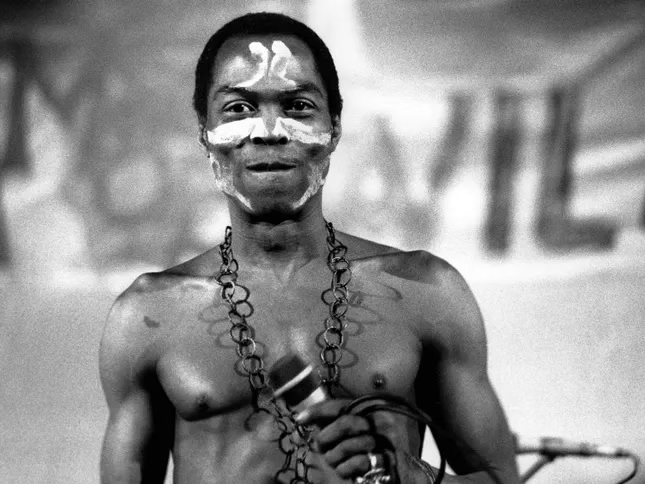
When the Recording Academy posthumously handed Fela Anikulapo Kuti a Lifetime Achievement Award at the 2026 Grammy Awards making him the first African artist to receive this honour it wasn’t just a recognition of music. It was a global acknowledgement of a man whose voice shaped continents and whose art doubled as resistance.
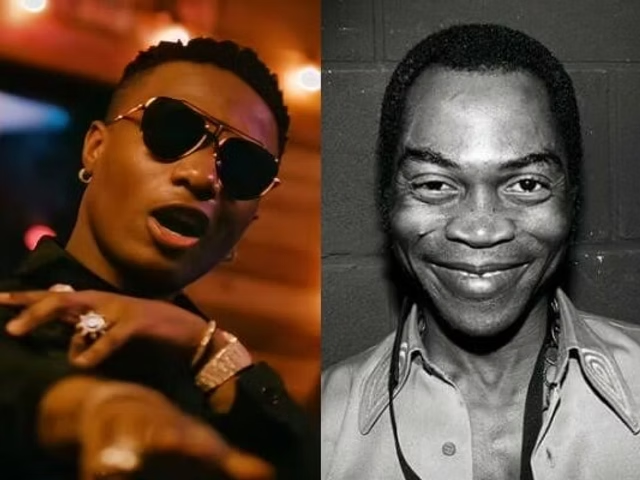
But as the internet lit up with takes, memes, and the inevitable Wizkid vs. Fela arguments, one thing became clear: most people still don’t understand why this moment matters. President Bola Tinubu publicly praised Fela’s award, calling him a “fearless voice of the people,” a “philosopher of freedom,” and a revolutionary force whose music confronted injustice and reshaped global sound. His words echoed a truth that many of us already feel but rarely articulate Fela was not just a musician; his art was a political weapon, a cultural manifesto, and a disruptive force decades before social media existed.
And this is where the deeper issue in Africa’s popular debates reveals itself: we confuse visibility with significance. Wizkid is undeniably one of Africa’s biggest global entertainers his streams, stages, collaborations, and influence in pushing Afrobeats into the mainstream are historic. But Fela’s impact was different in scale and form. It wasn’t about algorithms or playlists; it was about reshaping the very way Africans see themselves and speak truth to power with music as both voice and weapon.
So let’s be honest about what happened at the Grammys:
• This wasn’t the Grammys trying to “show Wizkid his place.” It was the world finally affirming a truth long known in Africa that Fela’s influence is foundational to African music and culture itself.
• Yes, Wizkid is a global superstar. But this award recognized a pioneer whose legacy gave birth to entire genres Afrobeat into Afrobeats and whose art was inseparable from struggle.
If this Grammy honor teaches us anything, it’s that influence is not measured by streams alone. There’s a difference between being the face of a moment and being the reason the moment exists in the first place. Fela did the latter. And no viral argument can erase that.
What This Grammy Moment Really Means
Fela’s Lifetime Achievement Grammy was not about comparison it was about correction. It was the global music industry acknowledging a debt that had been overdue for decades. Long before Afrobeats had charts, playlists, or global stages, Fela laid the ideological and sonic groundwork. His music challenged power, reshaped African identity, and proved that sound itself could be political. That kind of influence doesn’t expire, and it doesn’t need weekly validation.
So no, the Grammy wasn’t given to “put Wizkid in his place.” Wizkid already has his place as one of the most successful African entertainers of all time. But this moment reminds us that success and significance are not the same thing. Wizkid represents how far African music has traveled globally; Fela represents why African music mattered long before the world was paying attention. One is the face of an era. The other is the reason the era exists.
If this debate makes people uncomfortable, that’s because it forces a harder conversation: how Africa measures greatness, legacy, and power. Until we learn to separate popularity from historical impact, we will keep recycling the same arguments louder each time, but no wiser. Fela and Wizkid are not enemies. They are chapters in the same story, written under very different conditions.
If you’re still asking “who is bigger,” ask yourself bigger at what and why that metric matters to you.